If you appreciate the work done on this blog, please consider making a small donation. Thank you!

If you appreciate the work done on this blog, please consider making a small donation. Thank you!

Monday, March 25, 2013

Jabez Banks Invitations

Jabez Banks, Jr.
In the recent post about the Mendenhall Mob I wrote about how nice it is to occasionally get a glimpse into the everyday lives of the 19th Century residents of Mill Creek Hundred, and how helpful it can be to come across something from their lives with which we can easily relate. Assuming that everyone has at one time received a party invitation, I have another example. A few months back I was given an envelope containing items relating to three events, all of which once belonged to an ancestor of the donor. There are two party invitations and one commencement program and ticket, all once belonging to a MCH native named Jabez Banks (1855-1927).

If the name sounds vaguely familiar, Jabez was mentioned briefly in the post about his brother, the local automotive pioneer Richard Banks. He was the son of Jabez and Jane Banks, English immigrants who settled originally in Christiana Hundred in the 1840's. In 1850 they were living in the area just west of Wilmington, near Dupont Road and Maryland Avenue (Rt. 4). Interestingly, this was very close to another newly-arrived English family, the Browns. By 1860, Jabez and Jane had moved to the same area in which several of the Brown sons also settled -- just west of Stanton.

Wednesday, March 13, 2013

Red Clay Creek Corridor Park and Greenbank Park Plan -- 1975

General outline of the Red Clay Creek Corridor Park area
In the mid-1970's, New Castle County found itself in possession of two properties in a state of flux, and it had to decide exactly what to do with them. One property -- Brandywine Springs Park -- had recently been acquired from the state, and the county was still trying to figure out what to do with it. The other property -- Greenbank Park -- had been the site of the County Workhouse (prison), which had just recently been torn down. The site was to become a county park, but what kind of park was still very much up in the air. As we all know, what ultimately happened to these sites was that Brandywine Springs stayed as a low-key, wooded park with a few ball fields and picnic pavilions, while Greenbank became an open sports-oriented space with ball fields and tennis, handball, and basketball courts.

Unknown to most (or at least until recently, to me), there was at least one other potential plan floating around during those high-flying Ford Years. I have no idea how seriously this plan was taken, or whether it ever had any real chance of being implemented. My gut feeling is that this was strictly a "Let's see what we can come up with on the ambitious end of things" kind of plan, and I have a hard time imagining it being adopted. And even if it had somehow miraculously been adopted, the continuous funding and effort it would have entailed would have made it an easy target any time budgets needed to be trimmed. Even with the strongest of supporters, I couldn't see most of the plan lasting very long.

Wednesday, March 6, 2013

The Kiamensi Road House

Kiamensi Road House
This one is much less of a normal blog post for me, and more of just a picture gallery. The photos below are of a house on Kiamensi Road, just east of Stanton Road. It stands almost directly across from the entrance to Powell Ford County Park. I don't really have very many concrete facts about the house at present, so a few educated guesses will have to suffice. Needless to say, if more information about the property does surface, I'll definitely pass it along.

Judging from its style, the house was probably built sometime in the 1870's or 1880's, and was almost certainly connected to the Kiamensi Woolen Mill just down the hill along Red Clay Creek. During that era, the mill employed dozens of workers and had surrounding it a small village, which probably extended most of the way from Stanton Road to the Red Clay. By 1888, Scharf states that the company owned 26 dwellings, although it's unclear (to me, at least) whether this is solely at Kiamensi, or if that figure includes their Stanton mill as well. In either case, I'd be shocked in this house was not one of the 26.

Friday, March 1, 2013

The Mendenhall Mob

The Aaron Klair House
There were a number of reasons why I started writing this blog 2-1/2 years ago, one of them being to help combat what I felt was a common misperception. (I know I've said this before, but it bears repeating in this case.) I think that when a lot of people are asked, about Mill Creek Hundred, "What was around here 100, 200, or 300 years ago?", the common response would be, "Oh, it was all just farmland." And as we've seen here, that dismissive phrase is just not accurate. Although to be fair, even though MCH has been home to many other things over the centuries, the great majority of its expanse has been primarily used as farmland. But with those farms, it's important to bear in mind that they were built, lived on, and worked by real people. I know that sounds on the surface like a simplistic idea (of course there were "real" people there), but it's one I feel gets overlooked sometimes.

I think the main reason it's so easy to forget that those names we see on maps and census rolls represent real people is that we rarely get personal, up-close glimpses into their lives. Once in a while we have a photograph or two of a 19th Century resident, which is always wonderful. There's no better way to be reminded of the "realness" of someone than to actually look into their eyes, to see the part of their hair, to take in their crooked smile or the wrinkles on their face. [I don't know if I mention this enough, but if anyone ever has or knows of any old photos of people or places in the area, please let me know.] Other times -- even more rarely, it seems -- we come across a personal story from their lives that makes you think, "Yeah, they sound just like some people I know. I understand exactly how they felt and what they were thinking." This is a whole other level of "realness", and it's why I love the story of The Mendenhall Mob.

Monday, February 25, 2013

MCH History Gathering a Success!!!

I'm here to unilaterally declare Saturday's Inaugural Mill Creek Hundred History Gathering a smashing success. (Did you not see the three -- count 'em, three -- exclamation points in the title? I don't use them lightly.) The day was a bit dreary, but luckily it wasn't really raining while we were there. The venue was fabulous. How perfect was it to be talking about history in a 200+ year old house, overlooking a 200+ year old mill on the site of one a century older? It certainly made all our talk seem very appropriate. Many thanks go out to Greenbank Mill Associates for allowing us the use of the room. And thanks to the generosity of our attendees, we ended up making a $90 donation to GMA as a way of showing our appreciation. "Thanks" to everyone!! I couldn't have been happier with how it all went.

I'm a very bad host and didn't get a precise count of how many people we had, but I'm pretty sure there were about 22 or 23 of us, give or take. After we all sat down, we went around the room and had everyone introduce themselves and say a few words about their particular interest or connection to MCH history. I have to admit that I generally don't like things like that (I hate being called on to talk about myself in meetings or in classes), but it seemed like a good idea for the situation. Very few of us there knew one another in person, so it felt like a good way to get the "Oh, so you're so-and-so" out of the way up front. That went well (thanks everyone for playing along), and it even sparked a few discussions as we went.

Friday, February 22, 2013

The Greenbank Mill and the Philips House -- Part 2

Greenbank Mill and the Madison Factory
In Part 1 of this post, we traced the early history of the Greenbank Mill and the Philips House, which are located on Greenbank Road just down the hill from Price's Corner. We saw that the original log "Swedes Mill" was purchased in 1773 by Robert Philips, who then built a larger frame mill next to it in 1790. A few years after that he built a new stone house for himself and his family. Around the time of the War of 1812, Robert and son John R. Philips entered the wool manufacturing business, and built the stone Madison Factory on the site of the recently razed Swedes Mill. The wool business was not kind to them, and by the early 1820's the mill had been seized by the sheriff for unpaid debts, and John R. had moved away.

Robert Philips died in late 1828, and in 1830 the property was finally sold to his nephew, John C. Philips. For the next twenty years or so, John C. Philips (1782-1854) operated the grist mill, as well as a saw mill that was installed sometime before 1822. (The saw mill was mentioned in an ad attempting to sell the mills that year, but since it was not uncommon to have a saw mill operating alongside a grist mill, it could have been in place much earlier). Eventually John was joined in business by several of his sons, who would initiate the next chapter in the story of Greenbank Mill. And like with the woolen venture of their great uncle, these Philips brothers would be responding to changes in the business climate around them, albeit on a somewhat more local level.

Wednesday, February 20, 2013

The Greenbank Mill and the Philips House -- Part 1

Greenbank Mill in the 1960's, before the fire
The power of the many streams and creeks of Mill Creek Hundred has been harnessed for almost 340 years now, as the water flows from the Piedmont down to the sea. There have been literally dozens of sites throughout the hundred where waterwheels once turned, but today only one remains. Nestled on the west bank of Red Clay Creek, the Greenbank Mill stands as a living testament to the nearly three and a half century tradition of water-powered milling in MCH. The millseat at Greenbank is special to the story of MCH for several reasons -- it was one of the first harnessed here, it's the longest-serving, and it's the only one still in operable condition. The fact that it now serves as a teaching tool only makes it more special, at least in my eyes.

The early history of the millseat at Greenbank is a riddle, wrapped in a mystery, inside....Ok, it's not quite that bad, but the actual facts are far from clear. The precise details (such as they can be determined) probably need to be tracked down in another post, but the short version of the accepted facts is that the land on which the mill stands was patented in 1677 to a Swede named John Anderson (Stalcop). Part of Anderson's tract was later acquired by Thomas Bird (who was the son-in-law of Cornelius Empson, part-owner of the Stanton Mill), upon whose death the property was left to his son, Empson Bird. It was from Empson Bird that the property was purchased in 1773 by Robert Philips.

Saturday, February 9, 2013

Inaugural MCH History Gathering -- Location Revealed!!!

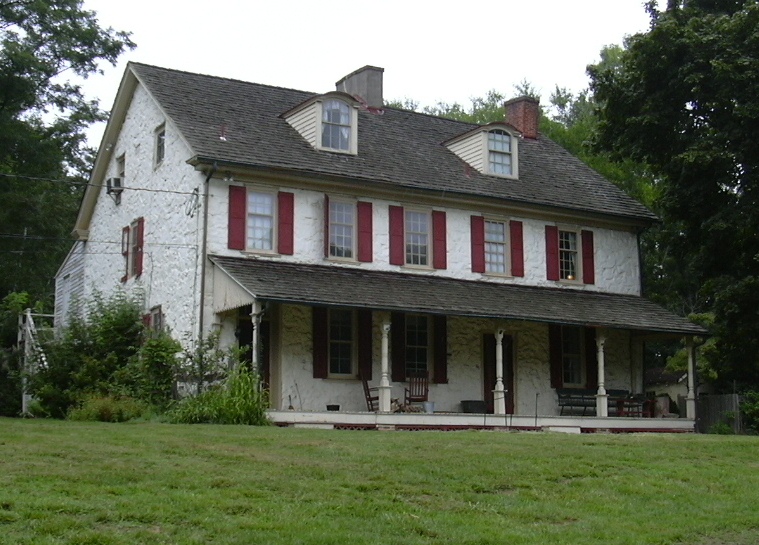
The Philips House
At first I wasn't sure what kind of a venue we'd be able to get for our get-together, but I figured I'd come up with something. In all honesty, any old room somewhere would have sufficed, but I never expected to be able to secure the kind of perfectly suited location for the event that I did. The Inaugural Mill Creek Hundred History Gathering will take place at 2:00 PM, Saturday February 23, 2013 at.....The Philips House at the Greenbank Mill. Thanks to the suggestion on the FaceBook page from Laurel Haring (who is a board member at the mill, and I understand will be joining us at the event) I contacted the mill, and they were kind enough to allow us to meet in the house. Thank you to Abby for helping me to coordinate this!

I really don't know if there's too much better and more appropriate of a location for a historical gathering than in a house built in 1794, next to the only remaining historic mill in Mill Creek Hundred. And in case you're wondering, I do plan on having a Greenbank Mill post up sometime before the event, for anyone not familiar with this historic, but vibrant, property. I'm very excited about this location for our get-together, and I hope you are, too.